IL是区别于传统手动编程来赋予机器人自主能力的方法。 IL 允许机器通过演示(人类演示专家行为)来学习所需的行为,从而消除了对显式编程或特定于任务的奖励函数的需要。 IL主要有两个类别:
行为克隆(BC)
反向强化学习(IRL)
Behavior Cloning
BC 是一种 IL 技术,它将学习行为的问题视为监督学习任务 。 BC 涉及通过建立环境状态与相应专家操作之间的映射来训练模型来复制专家的行为。专家的行为被记录为一组state-action pair,也称为演示。在训练过程中,模型学习一个函数,利用这些演示作为输入,将当前状态转换为相应的专家操作。经过训练,模型可以利用这个学习函数来生成遇到新状态的动作。
不需要了解环境的潜在动态,计算效率很高,相对简单的方法。
The covariate shift problem: 测试期间观察到的状态分布可能与训练期间观察到的状态分布有所不同,使得代理在遇到未见过的状态时容易出错,而对于如何进行操作缺乏明确的指导。BC监督方法的问题是,当智能体漂移并遇到分布外状态时,它不知道如何返回到演示的状态。
The agent strives to deceive the discriminator by generating trajectories closely resembling those of the expert.
Imitation From Observation
仅通过图像序列来学习,不需要具体的关节动作操作数据。
Unlike the traditional methods, IfO presents a more organic approach to learning from experts, mirroring how humans and animals approach imitation. Humans often learn new behaviors by observing others without detailed knowledge of their actions (e.g., the muscle commands). People learn a diverse range of tasks, from weaving to swimming to playing games, by watching online videos. Despite differences in body shapes, sensory inputs, and timing, humans exhibit an impressive ability to apply knowledge gained from the online demonstrations
If we go to qubits, not much in this picture changes. While a qubit has infinitely many possible states, it turns out that you should look at what is called the basis of the state space, which loosely said means that you should find the minimal number of states in which you can express every other state. For a qubit, this turns out to be two, for example the up state and the down state. To use the language from above, each qubit therefore has 2 ‘possible assignments’, and you have n of them, so by the arguments presented above, there are $2^ⁿ$ unique states. Because we are doing quantum mechanics, superpositions of these states are also allowed, but that doesn’t change the picture: the dimensionality of the system is still $2^ⁿ$.
Qubits是由单个光子的量子态决定的,的存储维数限制依然是 $2^n$
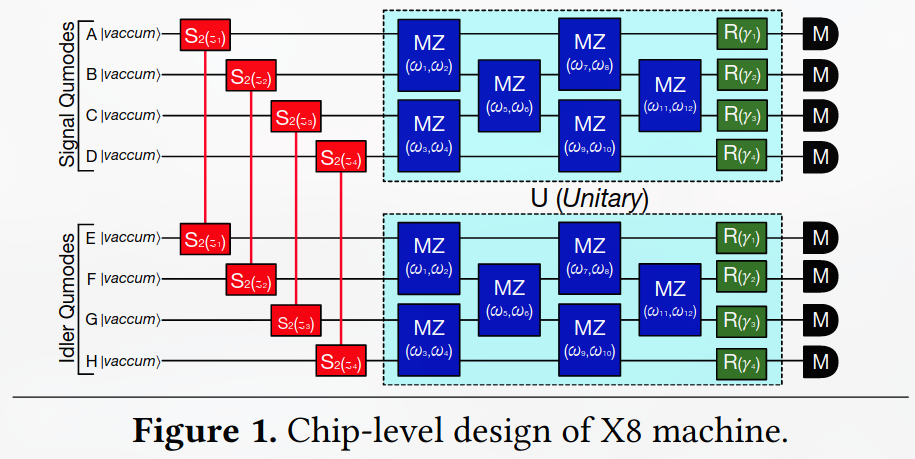
States for qumodes
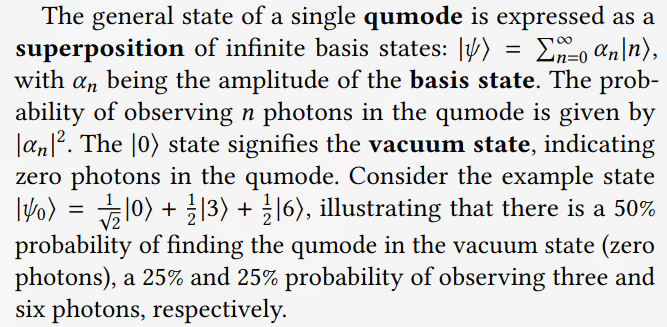
相较于qubit,qumode针对的是一个光场的状态,理论上可以有无限state
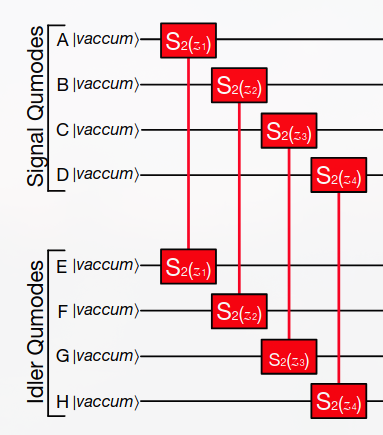
Squeezing gates
Squeezing gates on the vacuum state generate different states in the qumodes
S2 gate generates the Two-mode Squeezed Vacuum (TMSV) state when applied to the vacuum state |0, 0⟩ which can be mathematically expressed as