Chen Yulin's BlogChen Yulin's Blog
HomeArchivesCategoriesTagsAbout
  • Tags
  • MultiModal
MotionGPT3
Posted 2026-04-07Updated 2026-04-16Review11 minutes read (About 1632 words)

MotionGPT3

MotionGPT3 - Human Motion as a Second Modality

论文 arXiv | GitHub


研究背景

文本(Text)是离散符号,动作(Motion)是连续信号,两者性质截然不同。现有方法面临两个核心矛盾:

  • 量化误差(Quantization Error):将动作离散化为 VQ 码本索引以适配 LLM 的 next-token prediction,会引入近似误差,衰减高频细节,破坏语义-物理一致性
  • 跨模态干扰(Cross-Modal Interference):在单流(Single-Stream)骨架中混合文本与动作 token,梯度相互拉扯,导致训练不稳定、收敛慢

研究目标

提出一个统一的动作-语言模型,同时支持:

  • Text-to-Motion(T2M):文本描述 → 生成动作
  • Motion-to-Text(M2T):动作序列 → 生成文本描述

且需要避免量化误差,减少跨模态干扰。


核心概念

Mixture-of-Transformers(MoT)

来自 Liang et al. (2024) 的思想:为每个模态配备独立的 Transformer 分支,各自拥有独立的 Embedding、FFN 和 LayerNorm,仅在 Self-Attention 层共享。这样:

  • 各模态保留自身的归纳偏置(Inductive Bias)
  • 跨模态信息仅通过 Attention 受控交换
  • 新增模态只需新增分支,无需重训全部参数

连续动作表示(Continuous Motion Representation)

使用预训练的 Motion VAE 将动作编码为连续 latent 向量(而非 VQ 离散索引),避免量化误差。


研究方法

整体架构

1
2
3
4
5
6
                Motion VAE                    Bimodal LLM                   Motion VAE
┌───────────┐ ┌────────────────────┐ ┌───────────┐
原始动作 m ───→│ Encoder E │──→ z₀ │ Text Branch T │ │ Decoder D │──→ 动作
│ 9层Trans. │ │ Motion Branch M │ │ 9层Trans. │
│ 4头,skip │ │ + Diffusion Head H │──→ ẑ₀ ──→│ 4头,skip │
└───────────┘ └────────────────────┘ └───────────┘

1. Motion VAE

  • 来自 Xin et al. (2023)(MLD)
  • Encoder $\mathcal{E}$: 将 $N$ 帧动作 $m^{1:N}$ 编码为单个 latent $z \in \mathbb{R}^{256}$
  • Decoder $\mathcal{D}$: 将 latent $z$ 解码回动作序列
  • 训练目标:重建损失 + KL 正则
  • 预训练后冻住,不参与后续训练
  • 动作长度信息隐式编码在 latent 中,Decoder 可生成变长输出

2. 双分支 Bimodal Transformer(MoT 架构)

两个并行分支,基于 GPT-2 配置(12 层,维度 768,MLP 维度 3072):

组件 Text Branch $\mathcal{T}$ Motion Branch $\mathcal{M}$
初始化 预训练 GPT-2(124M) 从零训练(238M)
Embedding 文本 Embedding 独立 Motion Embedding
FFN 独立 独立
LayerNorm 独立 独立
Self-Attention 共享 共享

路由机制:硬路由(非学习),由特殊标记决定——

  • <som> / <eom> 界定动作边界
  • <motion_in> / <motion_out> 标记 I/O 位置
  • 文本 token($\vartheta_i = 0$)→ Text Branch
  • 动作 token($\vartheta_i = 1$)→ Motion Branch

3. 动作接口模块

由于动作是连续信号,不能复用文本的 Embedding lookup 和 softmax 解码,需要专用接口:

  • MUH(Motion Understanding Head):线性投影,将 VAE latent 映射到 Transformer 输入空间(理解任务)
  • MGH(Motion Generation Head):即 Diffusion Head $\mathcal{H}$,将 Transformer 隐状态映射回 VAE latent 空间(生成任务)

4. Diffusion Head $\mathcal{H}$

轻量级扩散模型(3 层 MLP + ResBlock,隐藏维度 1024),在 VAE latent 空间中做去噪:
$$\mathcal{L}{\text{diff}} = \mathbb{E}{z_0, t, \epsilon}\left[|\epsilon - \mathcal{H}(z_t, h_m)|_2^2\right]$$

  • 训练时:对 $z_0$ 加噪得 $z_t$,$\mathcal{H}$ 以 Motion Branch 隐状态 $h_m$ 为条件,学习预测噪声 $\epsilon$
  • 推理时:插入 $K$ 个 <motion_out> 占位 token,Motion Branch 输出 $h_m^{v:v+K}$,$\mathcal{H}$ 从纯噪声 $z_T$ 逐步去噪(默认 100 步)得到 $\hat{z}_0$,再由 VAE Decoder 解码

训练策略:三阶段对齐

Stage I: Text-to-Motion 预训练

  • 冻住 Text Branch $\mathcal{T}$
  • 只训练 Motion Branch $\mathcal{M}$ + Diffusion Head $\mathcal{H}$
  • 任务:T2M(文本→动作生成)
  • 目的:让 $\mathcal{M}$ 在稳定的语言条件下学会动作语义
  • 100k iterations

Stage II: 跨模态对齐(Cross-Modal Alignment)

  • 仍冻住 $\mathcal{T}$
  • 引入多任务:T2M + M2T + Motion Prediction
  • 以指令格式呈现,促进双向对齐
  • 300k iterations

Stage III: 联合微调(Joint Fine-Tuning)

  • 解冻 $\mathcal{T}$,全参数微调
  • 混合文本-动作配对数据 + 纯文本数据
  • 50k iterations

主要发现

双流 vs 单流

  • 双流架构收敛速度约为单流的 2 倍(训练损失)
  • 验证指标(R@3, MMDist)收敛快 4 倍
  • 相同损失水平下,双流模型质量更优

连续 VAE vs 离散 VQ

  • VQ 方案在 R@3 约 0.5 时即饱和(天花板低)
  • VAE 连续表示持续改进,最终质量显著更高

实验结果

在 HumanML3D 上:

  • T2M:R@3 = 0.837,MMDist = 2.725,达到 SOTA
  • M2T:BertScore = 35.231,超越现有统一模型

讨论

优势

  • 避免 VQ 量化误差,保留高频运动细节
  • 双分支设计减少梯度干扰,加速收敛
  • 三阶段训练抑制跨任务干扰
  • 仅需 2 张 3090,训练高效

局限性

  • VAE 输出单个 latent,不支持长动作的分段组合生成
  • 方向性控制(左/右)有时会失败
  • 泛化能力受限于数据覆盖范围

与其他多模态架构的对比

架构类型 路由方式 代表 特点
单流 + Projector 无路由,全拼接 LLaVA, Qwen-VL 简单,但有跨模态干扰
MoE 学习的 Router, TopK 选专家 Mixtral, Switch Transformer 动态路由,扩展性好
MoT / 双分支 按模态硬路由,共享 Attention MotionGPT3 隔离前馈,受控交互

未来方向

  1. 分层/分段 latent:用 hierarchical 或 segment-wise latent 表示支持长动作和组合生成
  2. 更大数据集和更强 LLM:扩展训练规模,评估效率和鲁棒性
  3. 局部语义对齐:支持段级别的文本-动作精细对应

参考文献

  • Zhu, B., Jiang, B., Wang, S., et al. (2025). MotionGPT3: Human Motion as a Second Modality. arXiv:2506.24086.
  • Xin, T., et al. (2023). MLD: Motion Latent Diffusion.
  • Liang, C., et al. (2024). Mixture-of-Transformers (MoT).
  • Radford, A., et al. (2019). GPT-2.
#Research-paperDiffusionTransformerMultiModalMotionGenerationMoTVAE
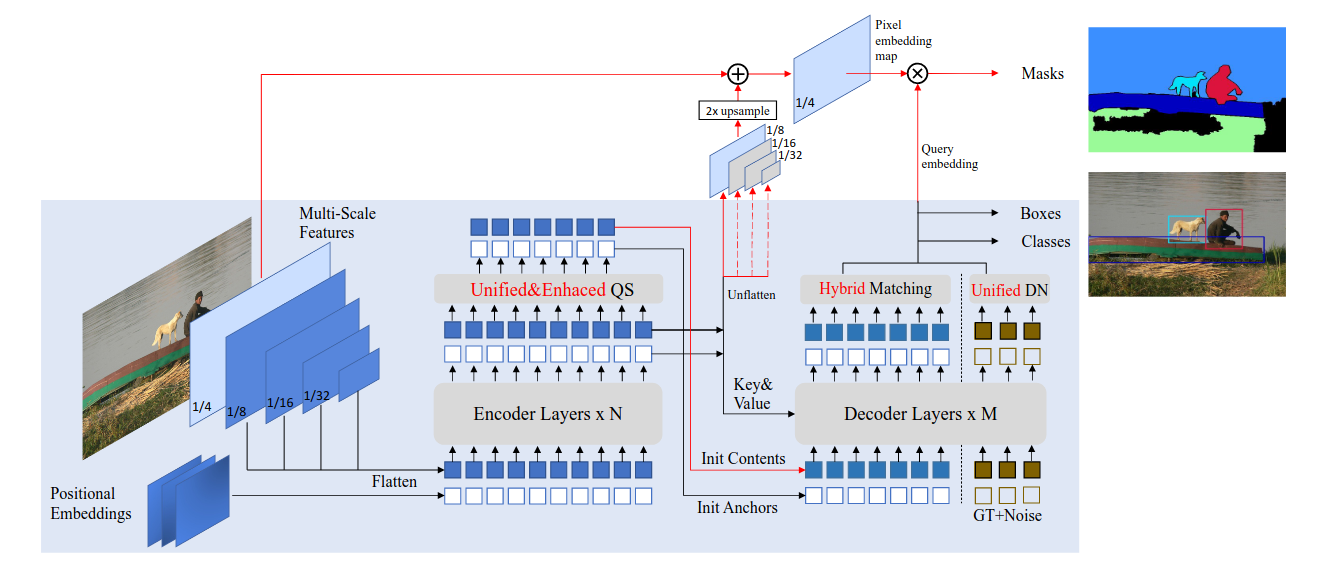
MaskDINO
Posted 2025-03-06Updated 2026-04-16Reviewa few seconds read (About 26 words)

MaskDINO

注:此DINO并非自蒸馏自监督的那个[[DINO]],而是派生自[[DETR]]

#CVObject-DetectionResearch-paperTransformerMultiModalSemanticSegmentation
ALBEF
Posted 2025-03-04Updated 2026-04-16Reviewa minute read (About 154 words)

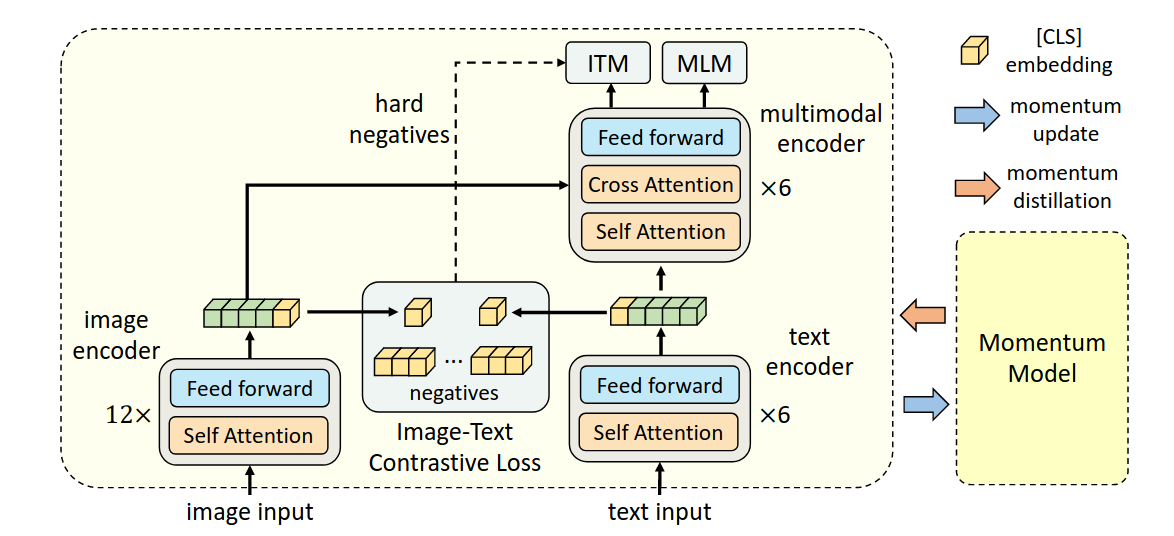
ALBEF

使用的backbone是BERT(通过MLM训练)
该研究认为,image encoder的模型大小应该大于text encoder,所以在text encoder这里,只使用六层self attention来提取特征,剩余六层cross attention用于multi-modal encoder。

#CVResearch-paperImage2TextMultiModalContrastive-LearningVLPImage-Text
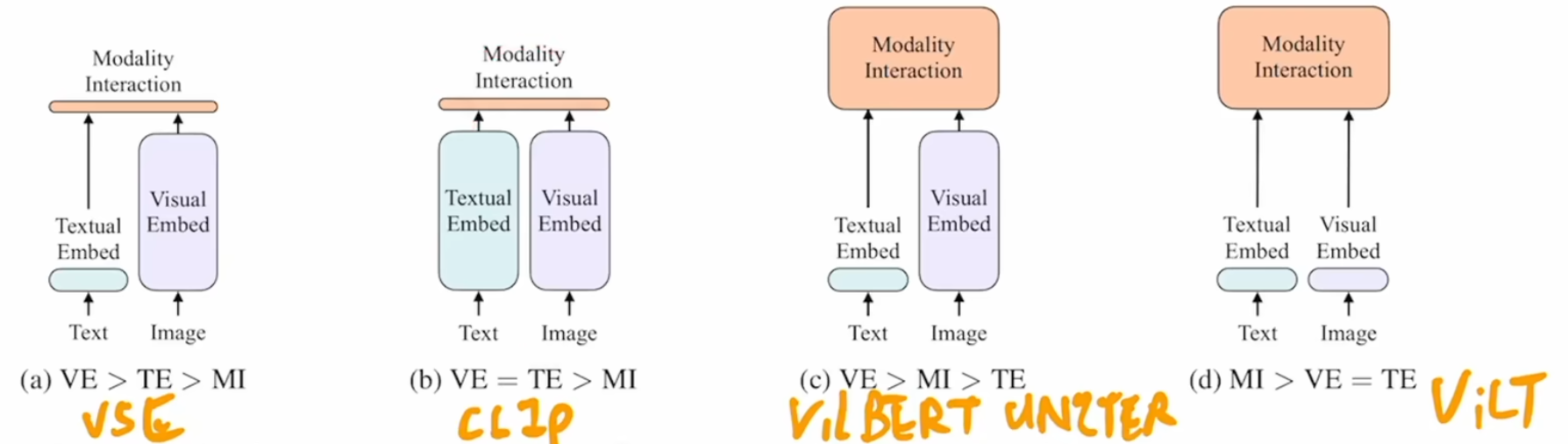
ViLT
Posted 2025-03-04Updated 2026-04-16Reviewa few seconds read (About 3 words)

ViLT

#CVResearch-paperTransformerImage2TextMultiModalVLPImage-Text
Grounding-DINO
Posted 2025-02-16Updated 2026-04-16Reviewa minute read (About 216 words)

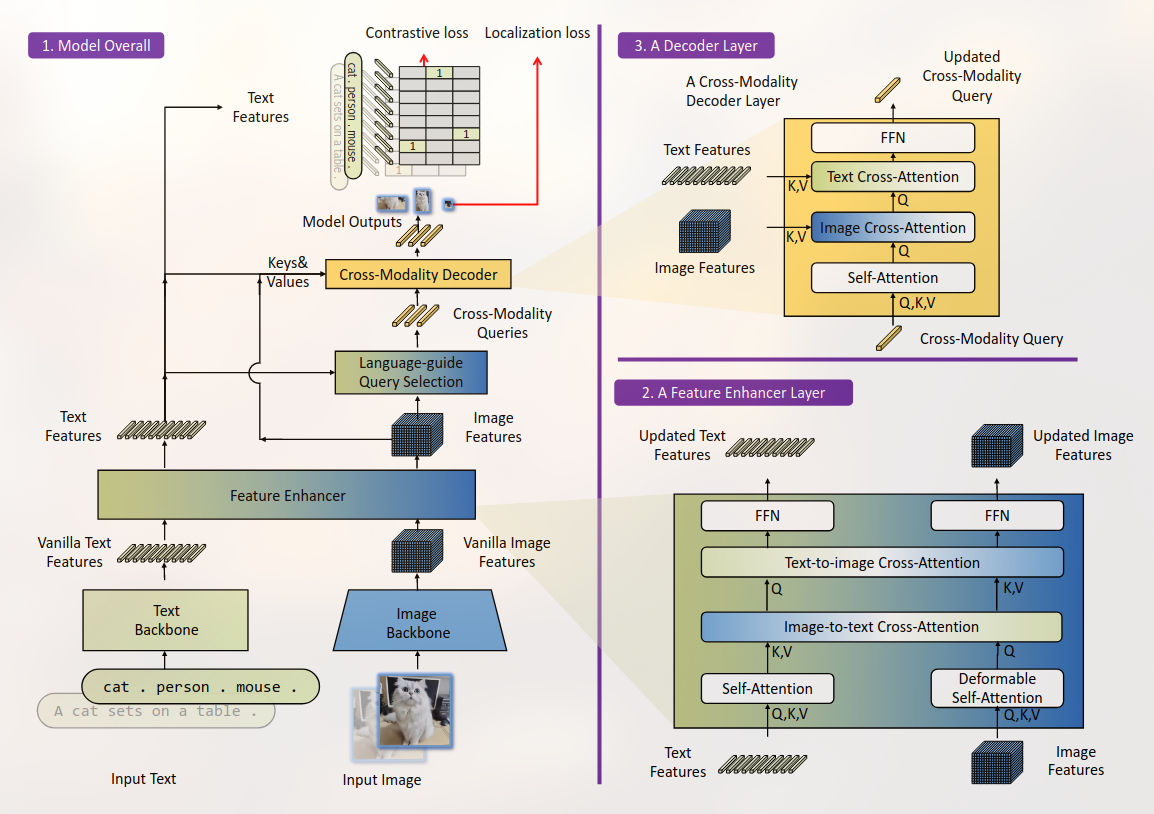
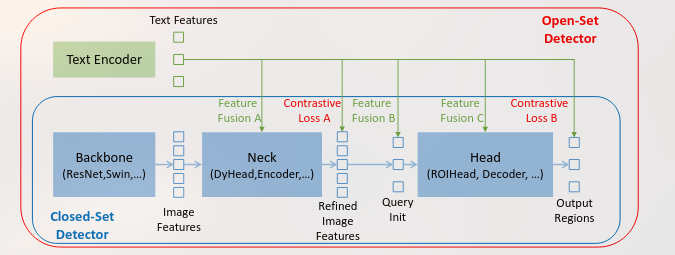
Grounding-DINO

,

#CVObject-DetectionResearch-paperTransformerMultiModalContrastive-LearningOpen-VocabularyDINOImage-Grounding
CLIP
Posted 2025-01-06Updated 2026-04-16Notea minute read (About 197 words)

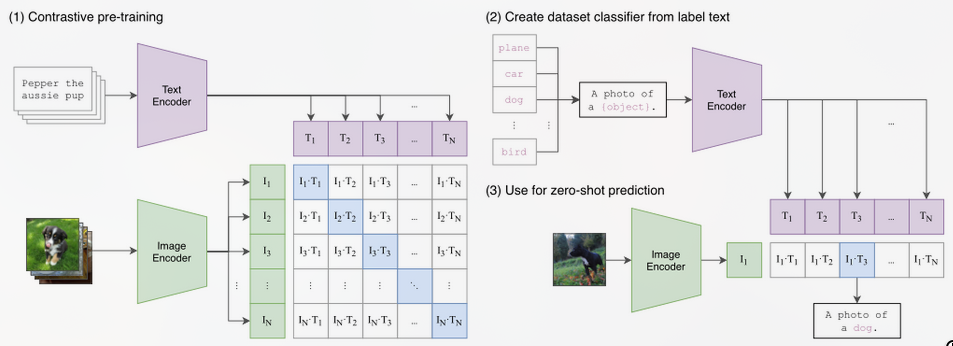
CLIP

https://blog.csdn.net/h661975/article/details/135116957

#CVResearch-paperImage2TextMultiModalCLIPContrastive-LearningVLPImage-Text
Chen Yulin

Chen Yulin

SJTU student

Manchester by the Sea

Posts

132

Categories

6

Tags

107

Follow

Archives

  • April 20261
  • February 20268
  • November 20253
  • July 20252
  • May 20252
  • April 20259
  • March 202540
  • February 20259
  • January 202512
  • December 20246
  • November 20242
  • October 20244
  • September 20246
  • August 20241
  • July 20241
  • June 20241
  • May 20241
  • April 20244
  • March 20241
  • January 20241
  • December 20231
  • May 20231
  • August 20221
  • May 20226
  • April 20229

Recents

MotionGPT3

2026-04-07

MotionGPT3

Review

exist_label

2026-02-14

exist_label

Note

BAGEL-Unified-Multimodal-Pretraining

2026-02-06

BAGEL-Unified-Multimodal-Pretraining

Review

LingBot-VLA

2026-02-05

LingBot-VLA

Review

Mixture-of-Experts-Survey

2026-02-05

Mixture-of-Experts-Survey

Review

Tags

3D-Scene17
Atlas1
CADC1
CLIP11
CNN1
CV56
Chemistry1
Contrastive-Learning5
Csharp1
DINO3
DT1
Debate2
Diffusion3
DiffusionModel4
Discrete-Mathematics1
Embodied-AI18
Emoation1
Emotion9
FL1
FPN2
Foundation1
FoundationModel4
Functional programming1
Game1
Gated-NN3
Github1
HRI2
Haskell1
Hexo4
Hierarchical4
Html1
HumanoidRobot1
Image-Grounding2
Image-Text4
Image-generation2
Image2Text7
ImgGen3
ImitationLearning5
LLM15
LatentAction1
Latex1
Love2
ML8
MR/AR3
Message-Passing2
MoE2
MoT1
Mod1
MotionGeneration1
Multi-modal14
Multi-view1
MultiModal6
NLP6
NN7
Nodejs1
Object-Detection9
Open-Vocabulary11
OpenCV1
Panoptic1
Physical-Scene4
Plugin1
PoseEstimation3
Probability1
Promise1
Python1
Pytorch1
QML1
Quantum1
RL3
RNN3
ROS3
Reading3
Real2Sim2
Reconstruct13
Representation-Learning5
Research-paper98
RobotLearning13
Robotics29
SJTU-Lecture1
Scalability2
Scene-graph31
Scene-synthesis2
Segmentation7
Semantic14
Signals and Systems1
Sim2Real1
Snippets1
Subgraph1
Survey4
Task-Planning9
Tech Communication1
Transformer21
Translation-Embedding2
Travel1
Unified-Multimodal1
Unity1
VAE2
VLA2
VLM8
VLP5
VQ-VAE1
ViT5
Vim1
Visual-Relation23
WSL1
Web1
WorldModel2
Chen Yulin's BlogChen Yulin's Blog

© 2026 Chen Yulin  Powered by Hexo & Icarus

×