Human-robot interaction for robotic manipulator programming in Mixed Reality
和我毕设很像的工作,居然已经发ICRA了?
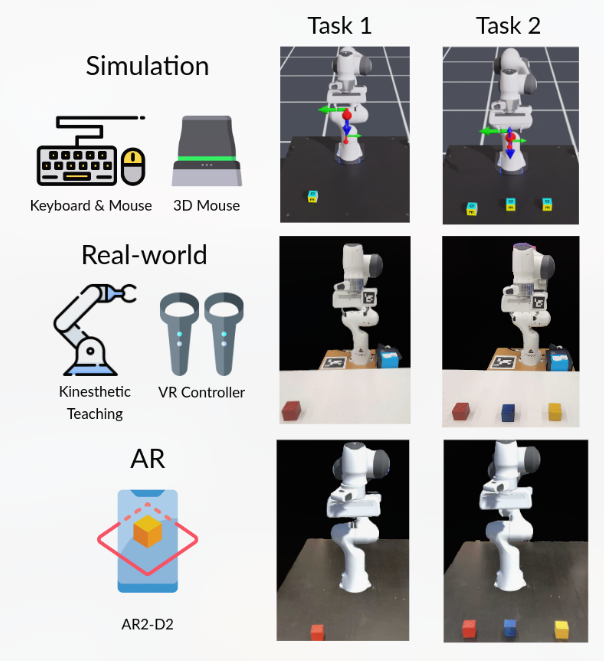
Human-robot interaction for robotic manipulator programming in Mixed Reality
和我毕设很像的工作,居然已经发ICRA了?

虽然近些年有关AR在人机交互方面应用的研究有很多,但是这些研究大都缺少系统性的分析
Recently, an increasing number of studies in HCI, HRI, and robotics have demonstrated how AR enables better interactions between people and robots. However, often research remains focused on individual explorations and key design strategies, and research questions are rarely analyzed systematically.
本文主要给目前AR人机交互领域做一下分类(基于460篇文章)
AR人机交互主要分为这几种研究维度
AR最大的优势就是能够提供超出物理限制的丰富视觉反馈,减少工人的认知负荷
这个研究最终的目标是提供一个对于该领域的共同基础和理解。
机器人系统不单指传统工业机器人,在本研究中,我们不局限于任一种机器人。
Robotic interfaces 主要指”Interfaces that use robots or other actuated systems as medium for HCI”.
该研究通过design space dimensions来呈现该领域的分类
拓宽了HCI和HRI的文献研究
讨论了促进该领域进一步研究的开放性研究问题和机会
有一个交互式网站 https://ilab.ucalgary.ca/ar-and-robotics/
根据增强现实硬件的布置位置(dimension 1),可以分为
这篇主要讨论呈现AR内容的方式
联邦学习(Federated Learning, FL)作为一种新兴的分布式机器学习方法,已经引起了大量研究的关注。要系统地理解联邦学习的相关研究,建议遵循以下结构化的阅读图谱,以便逐步加深对其原理、应用和挑战的理解。
这些论文介绍了联邦学习的基本概念、目标、以及经典算法,是了解联邦学习的起点。
Konečnỳ, J., et al. (2016). “Federated Learning: Strategies for Improving Communication Efficiency” arXiv
McMahan, H. B., et al. (2017). “Communication-Efficient Learning of Deep Networks from Decentralized Data” arXiv
Yang, Q., Liu, Y., Cheng, Y., Kang, Y., Chen, T., & Yu, H. (2019). “Federated Learning” ACM Transactions on Intelligent Systems and Technology (TIST)
联邦学习的一个重要目标是确保数据的隐私和安全,这一领域的研究为其提供了理论基础和技术手段。
Bonawitz, K., et al. (2017). “Practical Secure Aggregation for Federated Learning on User-Held Data” arXiv
Geyer, R. C., Klein, T., & Nabi, M. (2017). “Differentially Private Federated Learning: A Client Level Perspective” arXiv
Zhao, Y., et al. (2018). “Federated Learning with Non-IID Data” arXiv
联邦学习中的通信和计算效率问题是该领域的关键研究方向,许多研究尝试通过各种方法优化模型训练过程中的资源消耗。
Li, X., et al. (2020). “Federated Optimization in Heterogeneous Networks” arXiv
Kairouz, P., et al. (2021). “Advances and Open Problems in Federated Learning” arXiv
Chen, M., et al. (2020). “Joint Learning and Communication Optimization for Federated Learning over Wireless Networks” arXiv
要更好地理解联邦学习在实际中的应用和系统架构,可以参考一些开源框架和实际实现案例。
Google AI. “Federated Learning for Mobile Keyboard Prediction” Blog Post
TensorFlow Federated (TFF): GitHub
联邦学习在诸多行业中都具有广泛的应用,了解这些应用有助于扩展对联邦学习实际意义的认识。
Rieke, N., et al. (2020). “The Future of Digital Health with Federated Learning” arXiv
Hard, A., et al. (2019). “Federated Learning for Mobile Keyboard Prediction” arXiv
对于未来的研究,联邦学习还面临许多挑战,比如系统异质性、模型性能与隐私保护的平衡等。
通过这个图谱,你可以系统地了解联邦学习的关键领域,并逐步深入到各个具体问题的解决方法与研究前沿。
ProxiML -- Building Machine Learning Classifiers for Photonic Quantum Computing
https://dl.acm.org/doi/pdf/10.1145/3620666.3651367
Qumodes are a different way of carrying and manipulating quantum information than qubits.
就像二进制在电脑中的encoding方式,总共n bit的内存,那必然只能有 $2^n$ 种内存state,这是由二进制0或1的特性决定的。然后在让我们看qubit和qumode
If we go to qubits, not much in this picture changes. While a qubit has infinitely many possible states, it turns out that you should look at what is called the basis of the state space, which loosely said means that you should find the minimal number of states in which you can express every other state. For a qubit, this turns out to be two, for example the up state and the down state. To use the language from above, each qubit therefore has 2 ‘possible assignments’, and you have n of them, so by the arguments presented above, there are $2^ⁿ$ unique states. Because we are doing quantum mechanics, superpositions of these states are also allowed, but that doesn’t change the picture: the dimensionality of the system is still $2^ⁿ$.
Qubits是由单个光子的量子态决定的,的存储维数限制依然是 $2^n$
LSTM主要是用于解决递归网络中梯度指数级消失或者梯度爆炸的问题
https://www.youtube.com/watch?v=YCzL96nL7j0&t=267s
LSTM和RNN主要的区别就在于:LSTM有两条记忆链,一条短期记忆,一条长期记忆。
On the Properties of Neural Machine Translation= Encoder–Decoder Approaches
对比了 RNN Encoder-Decoder 和 GRU(new proposed)之间的翻译能力,发现GRU更具优势且能够理解语法。
因为会把要翻译的语句映射到固定长度的vector所以训练需要的内存空间是固定的且很小,500M和几十G形成对比。
但也有问题:
As this approach is relatively new, there has not been much work on analyzing the properties and behavior of these models. For instance: What are the properties of sentences on which this approach performs better? How does the choice of source/target vocabulary affect the performance? In which cases does the neural machine translation fail?
不够Fancy的地方:
递归神经网络(RNN)在变长序列x = ( x1 , x2, … , xT)上通过保持隐藏状态h随时间变化而工作
这是本文提出的用于替换RNN Encoder-Decoder 中的Encoder的一种新的神经网络,文中称为:gated recursive convolutional neural network (grConv)
如图a为Recursive convolutional NN (这是啥?) #question 图b为grConv grConv则是让隐藏层通过训练w参数可以从三个输入中挑选: 其中 $\omega_c+\omega_l+\omega_r=1$ 由此便获得了如图c,d所示的自主学习语法结构的能力。 非常直观的图 #paradigmTransformer是一种基于注意力机制,完全不需要递归或卷积网络的序列预测模型,且更易于训练
介绍了Gated-RNN/LSTM的基本逻辑[[Empirical Evaluation of Gated Recurrent Neural Networks on Sequence Modeling]],指出:
这种固有的顺序性质阻碍了训练示例中的并行化,这在较长的序列长度上变得至关重要,因为内存限制限制了示例之间的批处理,虽然后续有相关工作优化了一些性能,但是基本的限制并没有解除。
https://github.com/hkproj/pytorch-transformer/
https://www.youtube.com/watch?v=ISNdQcPhsts
关于Transformer 中的LayerNorm: https://dkleine.substack.com/p/understanding-layer-normalization?utm_campaign=post&utm_medium=web
参考: https://forum-zh.obsidian.md/t/topic/292
总结了各文章之间的 关联度,太直观了
Citexs Paperpicky
领域文献调研分析网络图将推荐文献可视化,在这里可以很容易看到文献之间的引用和被引用的关系。每个圆球代表一篇文章,圆球大小与共引次数正相关,从AI推荐文献、经典文献、核心文献三个维度给大家推荐出关联文献。
(1)AI推荐文献是根据所输入的关键词,智能筛选出与关键词高度关联的文献,在这里大家可以看到近期发表的研究成果;
(2)经典文献是基于推荐文献共引用关系筛选出的文献,一般都是该领域的必读文献,也就是说只要你研究该领域,这些文献肯定要读;
(3)核心文献则是AI推荐文献和经典文献重叠共引的部分。